Wednesday, 16 October 2024

The Hard Truth About Huddersfield’s Young: Where Do They Live and What Does the Future Hold

The Hard Truth About Huddersfield’s Young:

Where Do They Live and What Does the Future Hold?

It’s no secret that the younger generation in Huddersfield is finding it tough to get onto the property ladder. With the rising cost of living, stagnating wages, and stricter mortgage criteria, it's no surprise that fewer under-34s are becoming homeowners.


But just how grim is the picture? And is there hope on the horizon for those struggling to find a place they can truly call home?


Huddersfield's Housing Crisis: The Struggles of the Under-34s


According to statistics for the Kirklees Council area, there are 177,988 households in total.


Of these, 2.7% are headed by individuals aged between 16 and 24, while 13.3% are headed by individuals aged between 25 and 34.


Compared with 2.6% of all UK households that are made up of people aged between 16 and 24 and 13.5% of all UK households made up of people aged between 25 and 34.


Looking specifically at the 16 to 24-year-old households in Kirklees, they can be broken down as follows…

  • Owned Outright – 3.9%
  • Owned with a Mortgage – 13.5%
  • Social Housing – 22.1%
  • Private Rented – 60.5%

Nationally, this compares owned outright 3.6%, owned with a mortgage 10.2%, social housing 22.8% and private renting 63.5%.


Next, the 25 to 34-year-old households in Kirklees breakdown…

  • Owned Outright – 5.5%
  • Owned with a Mortgage – 39.4%
  • Social Housing – 16.1%
  • Private Rented – 38.9%

Nationally, this compares owned outright 4.1%, owned with a mortgage 35.5%, social housing 17.7% and private renting 42.7%.


For a town like Huddersfield and local authority area, these numbers paint a rather bleak picture of property ownership among the younger generation.


But why is this happening? The answer is multifaceted. It’s not just about rising house prices (although they certainly play a role). Wages in Huddersfield have not kept pace with inflation, and with lenders becoming more conservative, the amount of deposit required to secure a mortgage is higher than ever before (not because the % of deposit is higher, just the sheer pound note amount).


For young people who are already grappling with student debt and rising rental costs, saving for a deposit can seem like an insurmountable task.


The Shifting Sands of Homeownership


Yet, while it might feel like homeownership for the under-34s in Huddersfield is slipping further out of reach, it’s worth putting these figures into context. Homeownership isn’t something that young people have ever done en masse, at least not in the recent decades of the 2000s and 2010s.


While the baby boomer generation often bought homes in their early to mid-20s (in the 1970s and 1980s), the dynamics of homeownership have changed dramatically since then.


The average age of first times buyers in the 1980s was 26, now the average age is 31 years (34 in London).


In the 1980s, when the housing market was more accessible, people were more likely to buy a home at a younger age. However, times have changed, and today's generation is navigating a very different set of economic and social circumstances. The cost of housing has skyrocketed, while wages have not kept pace. Furthermore, younger people today are often burdened with additional expenses that weren’t as prevalent a few decades ago, such as student loans and rising living costs. This combination makes it much harder to save for a deposit and secure a mortgage.


But while the statistics may seem gloomy, there’s a silver lining if we look beyond the current market and consider the long term. In countries like Germany, homeownership doesn’t typically happen until later in life. Germans tend to rent for longer, often well into their 30s and 40s, before purchasing a home. Yet, when they do finally buy, they have more financial stability, higher incomes, and can often make larger down payments. The result? Less debt and more security in the long run.


This delayed homeownership is becoming more common in the UK, and Huddersfield is no exception. What we may be seeing is not a permanent decline in young homeowners but a shift in the timing of when people buy. Instead of purchasing homes in their 20s, more people are waiting until their mid 30s or even 40s, when they have a bit more financial stability.


The Hidden £18,311,148,466 Kirklees Equity


One key factor that we cannot ignore is the £18.3bn of equity tied up in the homes of the 50 year plus older generation in Kirklees.


Many of our older residents, who bought homes decades ago when property prices were more affordable, are now sitting on this substantial equity. As these homeowners begin to downsize or pass their properties onto their children, we may see a significant transfer of wealth to the younger generation. This could provide a lifeline for many would-be homeowners who are currently priced out of the market.


In Huddersfield, where family connections are strong, and homeownership is often passed down through generations, this transfer of wealth is likely to have a profound impact on the housing market in the coming years. As baby boomers and older Gen X-ers look to pass on their properties, many younger people may find themselves with the financial means to finally purchase a home.


What Does This Mean for the Future of Huddersfield Homeownership?


The future of homeownership in Huddersfield isn’t all doom and gloom. Yes, the statistics show that fewer young people are owning homes, but this isn’t a permanent trend. The numbers may be low now, but there are several reasons to be optimistic about the future.


Firstly, as more young people start to prioritise saving and look for ways to get onto the property ladder, we could see an increase in homeownership rates among the under-34s. Previous schemes, such as Help to Buy and shared ownership can also provide much-needed assistance for first-time buyers in Huddersfield.


Secondly, as the older generation begins to pass on their wealth and property, younger people will likely have more opportunities to purchase homes, either through inheritance or through financial gifts. This generational shift will undoubtedly play a significant role in the future of Huddersfield’s property market.


While homeownership might not be happening as early as it did in previous decades, it is still very much attainable for those who are willing to plan and save strategically.


There’s no denying that the market is tough, but with the right guidance and support, many young people in Huddersfield will find that they can, in fact, become homeowners.


The key is to be patient, stay informed, and seek out opportunities as they arise.


As we look towards the future, it’s clear that the property market in Huddersfield is changing. Young people may not be buying homes as early as they did in the past, but that doesn’t mean they never will.


In fact, the next few decades could see a rise in homeownership as wealth transfers down through generations and more young people become financially stable.


In conclusion, the Huddersfield property market may be challenging for those under 34, but it is far from hopeless. The combination of shifting generational wealth and changing attitudes towards homeownership means that while young people may be delayed in buying homes, they aren’t being locked out of the market entirely.


Huddersfield’s future homeowners are out there – they’re just waiting a little longer to step onto the ladder. Share your thoughts with a comment.


Thursday, 10 October 2024

A Tale of Two Huddersfield Property Markets and the Need for Realistic Pricing


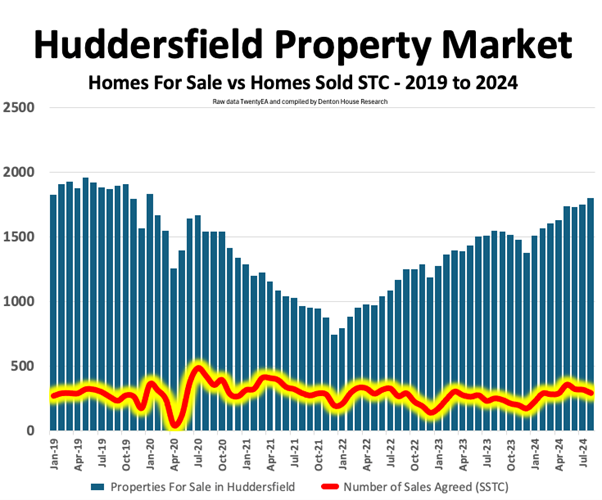
The Huddersfield property market has undergone significant changes over the past few years, as depicted in the two graphs provided. These visualisations capture the trends in the number of properties available for sale and the number of properties sold subject to contract (SSTC) from January 2019 to July 2024. By analysing these graphs, we can gain insight into the evolving dynamics of the local property market and the necessity for Huddersfield homeowners to adopt realistic pricing strategies, especially given the near doubling of available homes since mid-2022.


A Closer Look at the Huddersfield Market Dynamics (2019-2024)


From January 2019 to February 2020 (a normal market), the number of properties for sale in Huddersfield remained relatively stable, at an average of 1,847 homes (Huddersfield being HD1-5, HD7-8). This pre-COVID period also showed a steady number of properties being sold each month, with an average of 284 home sales. This indicates a balanced market where the supply of homes was more or less matched by buyer demand.


The Huddersfield property market underwent a noticeable shift with the onset of the COVID-19 pandemic in late March 2020. As the pandemic gripped the nation, the number of properties that sold in April and May 2020 plummeted sharply. This was due to the uncertainty brought about by the pandemic, with many potential buyers holding off buying a home amidst the economic uncertainty.


However, the floodgates opened once the property market lockdown was lifted in May/June 2020. The number of properties coming onto the market in June/July/August 2020 in the UK rose by 27.1% above long-term averages for the time of year, yet the number of homes selling also rose.


In Huddersfield, in the 20 months between May 2020 and December 2021, the average number of Huddersfield homes selling was 338 per month (one month, it even hit the heady heights of 484 homes sold stc). Yet, the number of homes for sale steadily dropped throughout that period to an all-time low of just 742 homes for sale in December 2021.


 What stands out during this period is that despite the reduced number of Huddersfield properties for sale, the number of properties sold remained robust. This surge in demand, despite a drop in available Huddersfield homes, can be attributed to the combination of pent-up demand and the government's intervention in the property market, mainly the stamp duty holiday, which incentivised buyers to move quickly.


As the dust started to settle from 2021 and as we moved into the first half of 2022, the property market started to feel like it was coming back to a ‘normal property market’ as the number of homes selling settled down and the general level of properties for sale also steadily began to rise.


However, just as we returned from our summer holidays in 2022, the Huddersfield property market was badly hit twice in a 12-month window.


The first hit was the Truss Budget in late 2022. In the five months following that budget, the average number of Huddersfield home sales dropped to an average of only 196 sales per month. It started to recover in the spring of 2023, as home sales rose to an average of 272 sales per month, only to be hit again when the increasing interest rates started to bite in the summer of 2023. Home sales in Huddersfield slumped to only 234 sales per month in the summer months of 2023.


Number of Huddersfield Homes for Sale Surge After January 2024


Since January 2024, the number of Huddersfield homes selling has been at an average of 298 homes sales per month, yet here is a fly in the ointment: the number of homes for sale has steadily risen to 1,804 in August 2024 alone.


This significant increase in supply could be due to various factors, including homeowners taking advantage of high property prices, an increase in new builds, or a growing number of properties that failed to sell in previous months being relisted.


Percentage Proportions: Huddersfield vs. UK Trends


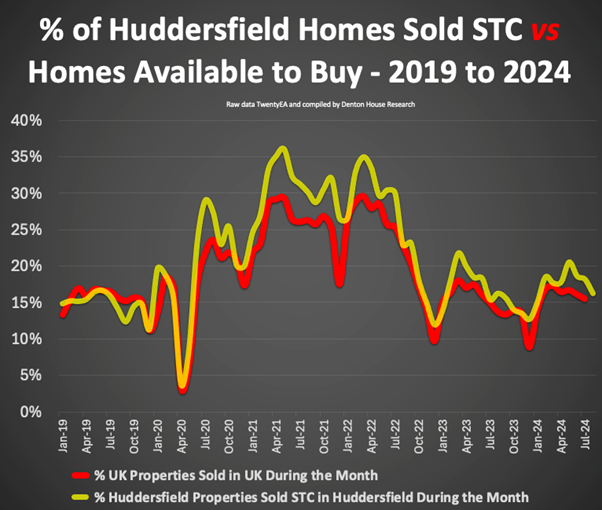
The second graph, set against a black background, delves deeper into this dynamic by comparing the same set of numbers against each other and expressing them as a percentage.


By doing that, we can analyse the proportion of monthly homes sold relative to the number of properties available.


The yellow line on the graph represents the percentage of Huddersfield properties sold SSTC during the month as a proportion of the homes for sale, while the red line for interest shows the equivalent figure for the entire UK.


This graph reveals quite telling information. Throughout 2020 and into early 2021, the proportion of homes sold in Huddersfield (yellow line) spiked into the mid-30%. This aligns with the earlier observation that, despite fewer homes being available, a higher percentage of these homes were being snapped up by eager buyers following the pandemic.


However, as we moved into 2022 and beyond, this trend began to reverse. The proportion of homes sold (as a percentage of the homes for sale) in Huddersfield started to decline, and now the figure now stands around the mid-teens.


What does it all mean for Huddersfield home movers?


The stable number of home sales against a backdrop of increasing supply could signal a potential issue: the market may be approaching a tipping point where supply begins to outstrip demand.


Given these trends, it’s clear that Huddersfield homeowners looking to sell their properties need to be mindful of the market dynamics. With the number of homes for sale having nearly doubled since mid-2022, competition among sellers is fiercer than in recent years. While buyer demand remains strong, it has not increased at the same rate as the supply of Huddersfield homes on the market, which could lead to longer times on the market and, potentially, downward pressure on prices.


In such a market, pricing becomes crucial. Huddersfield homeowners who are serious about selling need to ensure their properties are competitively priced to attract buyers.


Overpricing in a market with abundant choices could result in Huddersfield properties languishing unsold for extended periods. On the other hand, a realistic and attractive price point could make all the difference in securing a swift sale.


Also, remember that the longer a home takes to sell, the greater the chance the sale will fall through even when the sale is agreed upon. Looking at an examination from Denton House Research using data from TwentyEA, they noted that if a UK home sold within 25 days of the property coming on the market, the homeowners had a 94% chance of getting the sale through to completion (i.e. moving) with only a 6% chance of the sale falling through. If, however, the sale was agreed upon in more than 100 days, the chances of actually completing that sale and moving reduced vastly to only 56%, with a 44% chance of the sale falling through.


In conclusion, while the Huddersfield property market remains active, available homes have nearly doubled since mid-2022, this has introduced a new challenge for sellers. To achieve a successful sale, Huddersfield homeowners must pay close attention to market trends and set their prices accordingly. Realistic pricing and an understanding of the broader market dynamics will be vital in navigating this evolving landscape. As the data suggests, the market is still healthy, but the balance between supply and demand is shifting, making strategic pricing more critical than ever.


Monday, 7 October 2024

% of UK Rented in the Regions

 The latest Census data reveals the percentage of homes that are privately rented across various UK regions, providing insight into the distribution of private rental housing. Below is a list of each region by the percentage of homes privately rented: 

  • London: 30.0%
  • South West: 19.7%
  • Yorkshire & Humber: 19.4%
  • North West: 19.2%
  • South East: 19.2%
  • East Midlands: 18.7%
  • East Anglia: 18.2%
  • West Midlands: 17.9%
  • Northern Ireland: 17.2%
  • North East: 17.2%
  • Wales: 17.0%
  • Scotland: 12.4% 

London continues to lead with the highest percentage of privately rented homes at 30%, indicating the strength of the rental market in the capital. The South West, Yorkshire & Humber, the South East and the North West are above the national average of 19%, reflecting regional demand and supply, together highlighting any investment opportunities for landlords seeking to expand their portfolios?


It’s clear that private renting remains a significant part of the housing market across the UK, with regional variations influenced by national economic factors, property values, and local market conditions. 


If you're a Huddersfield landlord or considering becoming one, it’s vital to understand these national and local trends and what they mean for long-term profitability. 


Demand for Huddersfield rental properties remain robust, making this a favourable time to explore opportunities.


If you're looking for advice or further insight into the market, please read our updates on the Huddersfield property market or feel free to reach out on 01484 452314.


Whether you're an experienced Huddersfield landlord or exploring new investment opportunities, we're here to help you make informed decisions

Friday, 4 October 2024

1 in 9 Huddersfield Home Sellers Lower Their Asking Price Every Month


1 in 9 Huddersfield Home Sellers Lower Their Asking Price Every Month

As the property landscape in Huddersfield continues to evolve, many homeowners who have been on the market for a while find themselves navigating the complex decision of when and how much to reduce their asking prices to attract buyers.


With an increasing number of properties on the market in the Huddersfield area, rising from 1,169 in August 2022 to 1,806 in August 2024, the competition is becoming fiercer, making strategic price adjustments more crucial than ever.


(Huddersfield HD1-5, HD7-8)


Mastering Property Portal Price Bands for Optimal Exposure

Understanding and utilising price bands on the portals (Rightmove, Zoopla and OnTheMarket) can significantly enhance the visibility of your property listing. These bands are predefined price ranges that buyers often use to filter their search results. Positioning your property’s asking price in one of these bands will strategically draw more views, and thus more interest, viewings and ultimately increase the chances of achieving a sale.


The Importance of Rightmove Alerts

A critical factor in the timing of price reductions is their impact on buyer visibility. Homeowners need to reduce their asking price by at least 2% to ensure their property reappears in Rightmove and OnTheMarket’s email alerts, while for Zoopla it is 3%, capturing the attention of active buyers.


Current State of Play in the Huddersfield Property Market

Several Huddersfield home movers have said to me recently that they believe there are a greater number of price reductions happening at the moment, compared to a couple of years ago.


As I explained in the initial part of the article, the number of properties for sale has substantially grown in the last couple of years in the Huddersfield area. If there are a greater number of properties for sale, I would expect a great number of price reductions.


In 2022, there were an average of 125 price reductions a month in the Huddersfield area, today it’s 224 per month. The average Huddersfield price reduction in the last 3 months was 6.3%.

So, the statistics for the Huddersfield area reveal that while the number of properties for sale is on the rise, the number of reductions has increased. In fact, the percentage of Huddersfield properties undergoing price reductions has remained roughly consistent in recent years, with an average of 1 in 9 Huddersfield homes (11.1%) reducing their asking price each month over the last five and a half years.


The Ideal Pricing Strategy for Huddersfield Homes

The initial pricing strategy plays a pivotal role in the speed and success of your property sale. Huddersfield properties priced too high at the onset tend to linger on the market, eventually requiring more significant reductions to generate interest. In contrast, Huddersfield homes priced realistically from the beginning are more likely to attract offers quickly, reducing the need for substantial price cuts.


For Huddersfield homeowners considering a higher initial asking price, it’s advisable to be prepared to make an adjustment swiftly. A reduction within the first 2 to 4 weeks can prevent your property from stagnating on the market, whereas waiting 2 to 4 months might diminish your chances of securing a prompt sale.


Six Things to Consider for a Price Reduction

1. A Lack of Viewings: If you haven’t received many viewings in the initial few weeks, then look at your photographs and the write up on the portals and compare them with other properties in your price range. If they are up to standard, then it may be time to reconsider pricing and time to talk to your agent in more detail to attract more viewings.


2. Viewings But No Offers: The UK property market ‘viewings to offers ratio’ is between eight to ten viewings per offer. If your property hasn't received any offers within the first 30 days, yet you have had lots of viewings, that could suggest the price is a sticking point. You could ask why they don’t make an offer, yet research has shown many people don’t want to make an offer that they perceive could offend. Therefore, it could be time to consider a reduction and bring your asking price closer to your bottom line.


3. Low Offers: Homebuyers often make low offers for a variety of reasons, primarily to secure the best possible deal. One key factor is market conditions; in a buyer's market, where there are more homes available than there are buyers, purchasers feel they have more negotiating power. Another reason is property condition—if a home requires repairs or renovations, buyers may offer less to compensate for the additional investment needed. Sometimes, buyers also make lower offers based on their own budget constraints, hoping to enter a negotiation where they can find a middle ground. Additionally, uncertainty about the future Huddersfield property market may lead them to make more cautious, conservative offers. If you are getting low offers, it’s always smart to remember that a home is worth what someone's willing to pay.  Not what you think it's worth.


4. Market Saturation: Look at the number of Huddersfield homes that are on the market like yours (e.g. if you have a 2-bed apartment, look at all the 2-bed apartments on the market and sold stc). Look objectively at your home, do you stand out from your competition? Those that are sold stc should have a greater influence on your decision than those on the market. Also, ask your friends to do the same. Ask them to be 100% honest with you. Adjusting your price to become more competitive could help.


5. Seasonal Adjustments: Be mindful of the seasonal trends in the Huddersfield property market. Periods of high market activity might require different strategies from the slower months of say November and December.


6. Feedback from Viewings: Consistent feedback regarding the asking price of your Huddersfield home during viewings is a clear indicator that adjustments are necessary.


Leveraging Expert Advice

Given the complexities of the Huddersfield property market, seeking a second opinion from an expert such as ourselves can provide you with insights tailored to your specific situation. It's essential to choose a consultant who will offer honest advice, possibly telling you what you need to hear rather than what you want to hear.


Are you currently on the market in Huddersfield and contemplating a price reduction? Or perhaps you're seeking to list your property soon? For a no-obligation consultation and a fresh perspective on your property strategy, feel free to contact me. Together, we can ensure that your home is positioned effectively to attract buyers and achieve a successful sale.


Wednesday, 2 October 2024

9.1m Homes for Sale since January 2019

Since the 1st of January 2019, 9.1 million homes have come onto the UK property market.


We at Whitegates wanted to look at the breakdown of the distribution of property types within that figure. 


Most of these homes, 66% of these were houses. Flats made up around 20%, and bungalows accounted for 8%, reflecting the diverse nature of housing stock available across the country.


The remaining 6% includes various other types of properties, such as retirement homes, mixed-use residential and commercial properties, HMO’s and mobile homes etc. 


This data highlights the ongoing prominence of houses in the market, but also shows a significant portion of flats and bungalows, which cater to different buyer preferences and lifestyle needs.


For those interested in the property market, these figures offer a clear picture of the types of homes entering the market in recent years and provide useful insights for estate agents, investors, and potential buyers alike.


If you would like more information on the Huddersfield, regional and UK property markets, then please do follow us on social media, where we regularly post useful information on all three property markets.