
Thursday, 2 June 2016

Thursday, 26 May 2016
10% slump in Quarmby Property
Transactions
In this post credit crunch world of sub
terrain low interest and annuity rates so low a limbo dancer would smart, the
growth of buy to let since 2009 has been phenomenal. So much so, there has been
an evolution in purchase of property in the UK from that of just buying the roof
over one’s head to that of a buy to let investment where it is seen as a standalone
financial asset to fund current and future (ie pensions) investment. So
recently, a few days before the release of latest Land Registry data of property
transactions, quite a few market commenters were anticipating a huge increase
in the number of properties sold in January as the 1st of April
2016 stamp duty deadline got closer.
Looking at the most recent set of data
from The Land Registry, it seems there has been a rise in the number of
completed property sales in the Kirklees Metropolitan Borough Council area.
Year on year, completed property sales in January (the latest set of data
released) rose by 29.65% to 376 compared with 290 in January 2015.
Nationally, the number of completed house sales fell by 5% in January 2016
compared with January 2015. Some might say this bucks the market
trend that there was a rush by Huddersfield landlords to buy ‘buy to let’
property ahead of the 1st April 2016 deadline …
But looking even closer to home, in the HD3
postcode in January 2016, 27 properties changed hands, and 30 properties did so
in January 2015. It’s even more interesting when you look at the average price
paid, in January 2016, it was £156,109 yet in January 2015, the average price
paid was £140,188.
Is the buy to let dream over for Huddersfield landlords?
.. but as ever my Huddersfield Property
Blog readers, the devil is in the detail. The 3% stamp duty surcharge for buy
to let landlords was announced in the Autumn Statement on the 25th
November 2015. Anyone who has bought a property knows from their offer being
accepted to receiving the keys and monies paid is a long drawn out affair, taking
on average 8 to 12 weeks, as the Land Registry only get notified upon
completion of the sale. We also need to factor in that Solicitors seem to have
the last two weeks of December off anyway.
So if there was a rush in the last few
days of November/early December in the Huddersfield property market, we would
only see the results of that in the February figures (released in June) and
more probably March’s (released in July).
So why all the doom and gloom? Simple ..
bad news sells newspapers and gets the headlines. Let’s be honest, the headline
to this article is designed to be eye catching. However, when we look at both
the bigger and smaller picture; nationally, property values dropped (month on
month) by 0.5%; in the Yorkshire and Humber region they dropped 2.6%, whilst in
Kirkless they dropped by 0.3%. The year on year figures tell a completely
different story to that.
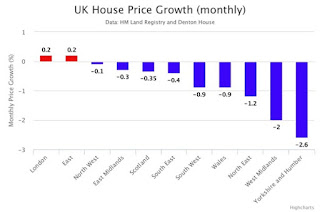
It just goes to show you should look
deeper into something before making a judgment! For more thought provoking
commentary on the Huddersfield property market – please visit the Huddersfield
Property Blog
Wednesday, 18 May 2016
5,365 Kirklees Properties lie empty– An injustice for the 9,160 people on the Kirklees Council House Waiting List?
Easy problems should have easy solutions - shouldn’t they?
Problems like Huddersfield’s housing crisis, where we have a rudimentary numerical
problem of too few homes for too many people ... the answer
is clearly to build more property in Huddersfield - but that, unfortunately for
those desperately seeking to purchase or let a property, takes a lot of time
and huge amounts of money. So what of other solutions?
Whilst at a dinner with friends recently, the subject of
property was mentioned (as I am sure it does at most dinner parties up and down
the country). Normally someone always mentions empty properties as the solution
to the problem. On the face of it, it seems so obvious. Now quite
interestingly, I had recently done some research on this topic, which I want to
share with you (as I did with those at the dinner table).
The most recent set of figures from 2015 state there are 5,365 empty
homes in the Kirklees Council area. So it begs the question ... why not put
them back onto the system and help ease the Huddersfield housing crisis? Whilst
they stand empty, 9,160 Kirklees households (not people – households) are on the
Council House Waiting List for council houses. Surely,
we can undoubtedly all agree that property left empty for years and
years isn’t morally right with the burgeoning Council House Waiting List, not
to also mention the issue of homelessness.
But a different story emerges when you look deeper into the
numbers. Of those 5,365 homes lying empty, only 2,217 properties were empty for
more than six months. The local authority has to report a property being empty,
even if it’s for a week. So many of the Huddersfield properties are either
awaiting new homeowners or, in the case of rental properties, new tenants. Also
most certainly, some properties are being refurbished and renovated, while
others properties have homeowners who are anxious to sell but cannot find a
buyer.
And this is where its gets even more interesting. Of the 2,217
long-term vacant properties (those empty more than six months), 258 belong to
the council. However, before we all go Council-bashing, anecdotal evidence
suggests these empty council houses are habitually in need of so much restoration
that it’s not worth the Council’s while to do and are in the roughest parts of
the council estates, they are properties that even the Council find difficult
to fill.
The fact is that the number of genuinely long term empty properties
is only a tiny drop in the ocean of the 173,525 properties in the area covered
by Kirklees Council and, even if every one of those empty homes were filled
with happy cheerful tenants tomorrow, it would only meet a small fraction of Huddersfield
housing needs.
So what does this mean for all the homeowners and landlords of Huddersfield?
Well it means with demand being so high, especially for rental properties, the
certainty of the rental market growing is an inevitability because young people
cannot buy and councils don’t have the money to build new council houses. This
in turn bolsters property prices as landlords continue to buy at the lower end
of the market (starter homes, etc), which in turn sustains the rest of the
market as those sellers move up the property ladder, releasing others in turn
to buy on again.
These are interesting times in the Huddersfield property market!
Friday, 13 May 2016
£3,200 boost to Huddersfield First time buyers
There’s a
whole legion of wannabe Huddersfield first-time buyers keen to get on the property
ladder and they now have a 3% price advantage over the previously quicker
responding army of Huddersfield landlords with cash at the ready. Since the
start of April, buy to let landlords have had to pay an additional 3% stamp duty so whilst demand from some Huddersfield buy to let landlords has
dropped away, in the interim, it offers Huddersfield first time buyers (FTB’s)
a chance to fill the vacuum with less competition from cash rich landlords (over two thirds of BTL properties were
purchased without a mortgage in the last 7 years) who could bid more and
complete quicker.
Looking at
the average value of a terraced house in Huddersfield currently standing at £109,900,
that means if our Huddersfield FTB went up against a Huddersfield landlord, the
landlord would have to pay an additional £3,297 in stamp duty. Early antidotal
evidence from fellow property professionals in the town is suggesting landlords
are reducing their offers slightly on Huddersfield properties to reflect the
extra stamp duty.
Whilst on the
face of it, it appears landlords are being punished by No.11 Downing Street, I
actually believe this increase in stamp duty for landlords is a good thing for
the Huddersfield property market as a whole.
Since
2011/12, the Huddersfield property market has performed very well indeed. Over
the last 12 months, £377,762,304 has been spent buying 2,346 Huddersfield
properties. Figures from the Land
Registry have just been released and month on month in our council area,
property values are 0.3% lower, yet 1.7% higher year on year. These figures are
nowhere near the heady days of 2004 (April to be exact), when Huddersfield
property prices rose by 29.6% in 12 months.
So as
property values in Huddersfield (and the UK as whole) start to stablise and
come back to some kind of balance, I am beginning to see savvy landlords view
the Huddersfield property market in a different light. Even with the Spring
rush, gone are the days where you could make limitless money on anything that
had a door, a few windows and roof. This stamp duty change has made more and
more landlords, after reading the Huddersfield Property Market Blog http://huddersfieldproperty.blogspot.co.uk/ take advice on
what or not to buy and what to pay, meaning Huddersfield landlords are being
more calculated with their Huddersfield BTL purchases. I am also seeing a variance between relatively brisk current price momentum and softer
expectations in terms of property value growth in Huddersfield, this in part
reflects amplified uncertainty about the short term economic outlook (eg Brexit,
Issues in the Far East etc).
Now I know a lot of Huddersfield
landlords brought forward their BTL purchases to beat the stamp duty deadline.
However, it is probable that hunger from Huddersfield investors will return for
the right Huddersfield property later in the year, especially if it’s at the
right price and offers a decent yield. However, in the meantime, Huddersfield FTB’s could and should, in the short term,
make hay whilst the sun shines plug the gap and grab a bargain!
Tuesday, 10 May 2016
Brexit and Huddersfield Property market – 12% more properties on the market
April Fools Day was no joke for
some landlords, as they rushed their buy to let property purchases throughout
late March to beat the extra 3% stamp duty George Osborne imposed on buy to let
properties after the 31st March 2016. Because some investors brought
forward their 2016 property purchases to save the extra tax, speaking to fellow
property professionals in Huddersfield, all of us have noticed, since the
clocks went forward, demand to buy in April and May from these landlords has
eased.
Then we have the Brexit issue, which is also having a
tempering effect on the Huddersfield property market – although if you recall I
wrote about this a few weeks ago, and whilst an exit will have an effect – it
won’t be the end of the world scenario some commentators are suggesting. In
another article I wrote previously, I spoke of the growth rate of Huddersfield property
values, and whilst the rate of growth is slowing, Huddersfield property values are
still 1.3% higher year on year, albeit the growth rate month on month has
started to moderate when compared to the heady days of month on month rises of 2014
and 2015. Interestingly though, a very recent members survey of the Royal Institution
of Chartered Surveyors states that only 17% of members believed property values
would increase over the next Quarter compared to 44% at the end of 2015.
All this had led to increase in the number of properties for
sale. For example in the HD2 postcode, which mainly comprises of Birkby,
Brackenhall, Bradley, Deighton, Fartown, Fixby and Sheepridge, there were 224 properties for sale in the postcode in
December (of which 22 came on to the market for the first time). In January,
February and March, 142 properties came onto the market in the postcode
district (or an average of 47 per month), meaning by end of the first Quarter,
there were 251 properties available for homeowners and landlords alike to buy
in HD2 (i.e. a rise of 12% more
properties for sale). These figures are mirrored in neighbouring postcodes
throughout the Huddersfield area.
Nevertheless, I believe this easing of the Huddersfield
property market is a good thing, as investment landlords wont have to pay top
dollar to secure a property because of the lower competition. On the face of
it, this easing should be bad news for the 107,657 Huddersfield homeowners, but
nothing could be further from the truth. The majority of homeowners that move,
move up market, (i.e. from a flat to
terrace/town house, then a semi and then detached), so whilst last year you
would have achieved a top dollar figure for your property, you would would have
had to have paid an even higher top dollar to secure the one you wanted to buy.
The Swings and Roundabouts of the Huddersfield
Property Market!
However, all the signals suggest that whatever the aftermath
of the approaching EU referendum, in the long term, the disparity between
demand for Huddersfield property and the supply (i.e. the number of actual
properties) will still exercise a sturdy and definitive influence on the Huddersfield
property market. It would surprise me that if by 2021, whichever way we vote in
late June, assuming we don’t have another credit crunch or issues like a major
world conflict, property prices will be between 15% to 18% higher than they are
today.
Wednesday, 27 April 2016
Huddersfield Property Market in Crisis : Who is to blame?
‘An Englishman’s Home is his
Castle’ is the phrase that was coined in Victorian times as the UK has a reputation
for being a country of home owners ..
but the truth could be further from the point, because in a league of the top
46 economic nations of the world, where owning your property is permissible,
the UK is only ranked no.37.
As I
mentioned a couple of weeks ago, at the end of the First World War, 77% of people
rented their home (the vast majority renting from a private landlord as Council
Housing was still very much in its infancy). Homeownership rose very slowly in
the 1920’s and started to grow as the economy grew after the Great Depression.
However, after the Luftwaffe had flattened huge swathes of housing in the early
40’s, the priority was to get people into clean and decent accommodation .. so
Local Authority’s (Councils) took up the baton and they built large council estates
in the 1950’s and 1960’s.
As the UK economy got back on its
feet in the middle part of the 20th Century and wages rose, people
decided they wanted to own their own home instead of renting. Throughout the post war decades,
it became easier to secure a mortgage. Interestingly, by 1977, 61.6% of 30 to
34 year olds were owner occupiers with a mortgage compared to 8.7% of 30 to 34
year olds being in private rented accommodation (the remaining either being in council housing or living with friends or
family). Ten years later, in 1987, we saw some significant growth in
homeownership, as 68.2% of 30 to 34 year olds had a mortgage and only 4.6% of
people privately rented. A decade later and there wasn’t much change as, in
1997, the homeownership figure was 68.3% but private renting had jumped to
12.1% in the same 30 to 34 year old age group.
Move on another
ten years to the 2007 figures, and this showed a slight drop in homeownership
to 65.8% but renting had continued to increase to 18.7% (in the 30 to 34 year
old age group). The latest set of figures is for 2014, and only 47.2% of 30 to
34 year olds had a mortgage and an eye watering 33.4% of 30 to 34 year olds
privately rent.
When we look
at the Huddersfield figures of homeownership, looking back to 1991, 58.94% of Huddersfield
households were owned by the homeowner, whilst 7.95% of Huddersfield households
were privately rented, whilst the 2011 census showed home ownership in Huddersfield
had dropped to 58.22% and private rented had increased to 19.57%. Much of the
recent rise in the occurrence of private renting in Huddersfield since the turn
of the Millennium is not because property has become more expensive, but the
fact these 30 somethings haven’t got
a council house to move into (because they were all sold off) – so they have to
rent. The selling of council housing in the 1980’s (a subject I have talked
about in a previous article in the Huddersfield Property Market Blog) artificially
grew homeownership in the 1980’s, but as these people have got older, the
younger generation didn’t have the same opportunity to buy their council house
in the 1990’s, 2000’s or 2010’s. That is why, unless the council start building
council houses by the acre, and hundreds of acres, private renting will
continue to grow in Huddersfield.
So if you
want blame anyone .. blame the Grocer’s daughter from Grantham – Mrs T …. but before you do – do remember in the 1970s, the
UK was called the "sick man of Europe" by critics of the UK government,
because of industrial strife and poor economic performance compared to other
European countries culminating with the Winter of Discontent of 1978/9 and if
it hadn’t been for her we wouldn’t be where we are today.
Wednesday, 20 April 2016
Rents in Huddersfield rise by 1.3% in the last year
I was reading the Sunday
Papers, as is my want and, when reading the financial pages, it was announced UK
inflation had increased to its highest level in a year. Inflation, as calculated
by the Government’s Consumer Prices Index, rose by 0.3% over the last 12 months. The report said it had risen to the those
‘heady’ levels by smaller falls in supermarket and petrol prices than a year
ago. If you recall, in early 2015, we had deflation where prices were dropping!
So what does this
mean for the Huddersfield property market ... especially the tenants?
Back in November, the Office of National
Statistics stated average wages only rose by 1.8% year on year, so when
adjusted for inflation, Huddersfield people are 1.5% better off in ‘real’
terms. Great news for homeowners, as
their mortgage rates are at their lowest ever levels and their spending power
is increasing, but the news is not so good for tenants.
The
average rent that Huddersfield tenants have to pay for their Private Rental
Properties in Huddersfield (i.e. not
housing association or council tenants) rose by 1.3% throughout 2015,
eating into most of the growth. 2015
wasn’t a one off either. In 2014, rents
in Huddersfield rose by 0.4% (where salaries only rose by only 0.2%) However, it’s
not all bad news for Huddersfield tenants, because in 2013 rents rose by 0.6%,
(but salaries rose by 2.2%).
… and it must
be noted that the private rents Huddersfield tenants have had to pay for Huddersfield
property since 2005 are only 18.6% higher, not even keeping up with inflation,
which over the same time frame, rose at 27.8% (although salaries were only 22.3%
higher over the same time period)
More and more,
talking to 20 and 30 somethings who
rent – it’s a choice. Gone are the days
where owning your own property was a guaranteed path to wealth, affluence and
prosperity. I know
keep mentioning Europe, but some of the
highest levels of home ownership are in Romania at 96.1%, Hungary at 88.2% and
Latvia at 80.9% (none of them European economic dynamos) and even West European
countries like Spain at 78.8% and Greece at 74% (and we know both of those
countries are on their knees, riddled with national debt and massive youth
unemployment).
At the other
end of the scale, whilst we in the UK stand at 64.8% homeownership, in Europe’s
powerhouses, only 52.5% of Germans own a home and only 44% of Swiss people are
homeowners. Looks like eating chocolate,
sauerkraut, renting and good economic performance go hand in hand. Yet, joking aside, home ownership has not always
been the rule in the UK. In 1918, only 23% of people were homeowners,
with no council housing, meaning in fact, 77% were tenants.
Tenants have choice, flexibility to
move, they don’t have massive bills when the boiler blows up, it’s a choice. Huddersfield rents are growing, but not as
much as incomes. To buy or not to buy
is an enormously difficult decision. For while buying a Huddersfield home is a dream
for the majority of the 20 and 30 something’s of Huddersfield have, it might
not leave them better off in the long run and it isn’t necessarily the best
option for everyone. That is why, demand
for renting is only going in one direction – upwards.
Subscribe to:
Posts (Atom)